
Vitamin D: The 'Sunshine Hormone' and Your Secret Internal Reservoir

In our Wisdom Within series, we love talking about the built-in intelligence of the body—how it’s always working to adapt, repair, and maintain balance when given the right support. Vitamin D fits that conversation perfectly.
Most people still think of it as “just a vitamin,” but technically, Vitamin D acts more like a hormone. Your body can make it, store it, activate it, and use it to influence everything from bone strength to immune readiness to nervous system balance.
And here at Carlucci Chiropractic & Wellness, that matters.
Why? Because the body doesn’t work in isolated parts. Your spine, your muscles, your ligaments, your nervous system, and your nutrition all talk to each other. When Vitamin D levels are in a good place, it helps support the structural and neurological foundation we care about every day in practice.
Let’s break down why this “sunshine hormone” is a bigger player than most people realize.
1. The D3 Advantage: Not All D Is Created Equal
When people say “Vitamin D,” they’re usually talking about one of two main forms:
Vitamin D2 (ergocalciferol)
Vitamin D3 (cholecalciferol)
Here’s the short version: D2 is the plant-based version, but D3 is generally the superior form for raising and maintaining blood levels of Vitamin D.
Why does that matter?
Because if you’re trying to support healthy function, you want the form that your body tends to use more efficiently—not the nutritional equivalent of showing up late and underdressed.
D2 vs D3 in real life:
Vitamin D2 is commonly found in mushrooms, especially those exposed to UV light, and in some fortified foods.
Vitamin D3 is found in animal-based foods like fatty fish and egg yolks.
D3 is also the form your body naturally makes in the skin when exposed to UVB light.
D3 generally does a better job raising blood levels of 25-hydroxyvitamin D, the marker commonly used to assess Vitamin D status.
It tends to stay active in circulation longer, which helps maintain steadier levels over time.
For many people, it’s simply the more reliable option when the goal is building and maintaining a healthy Vitamin D reserve.
So yes, mushrooms are great, but in the Vitamin D Olympics, D3 usually takes home the gold medal.
2. The Skin’s Chemistry Set
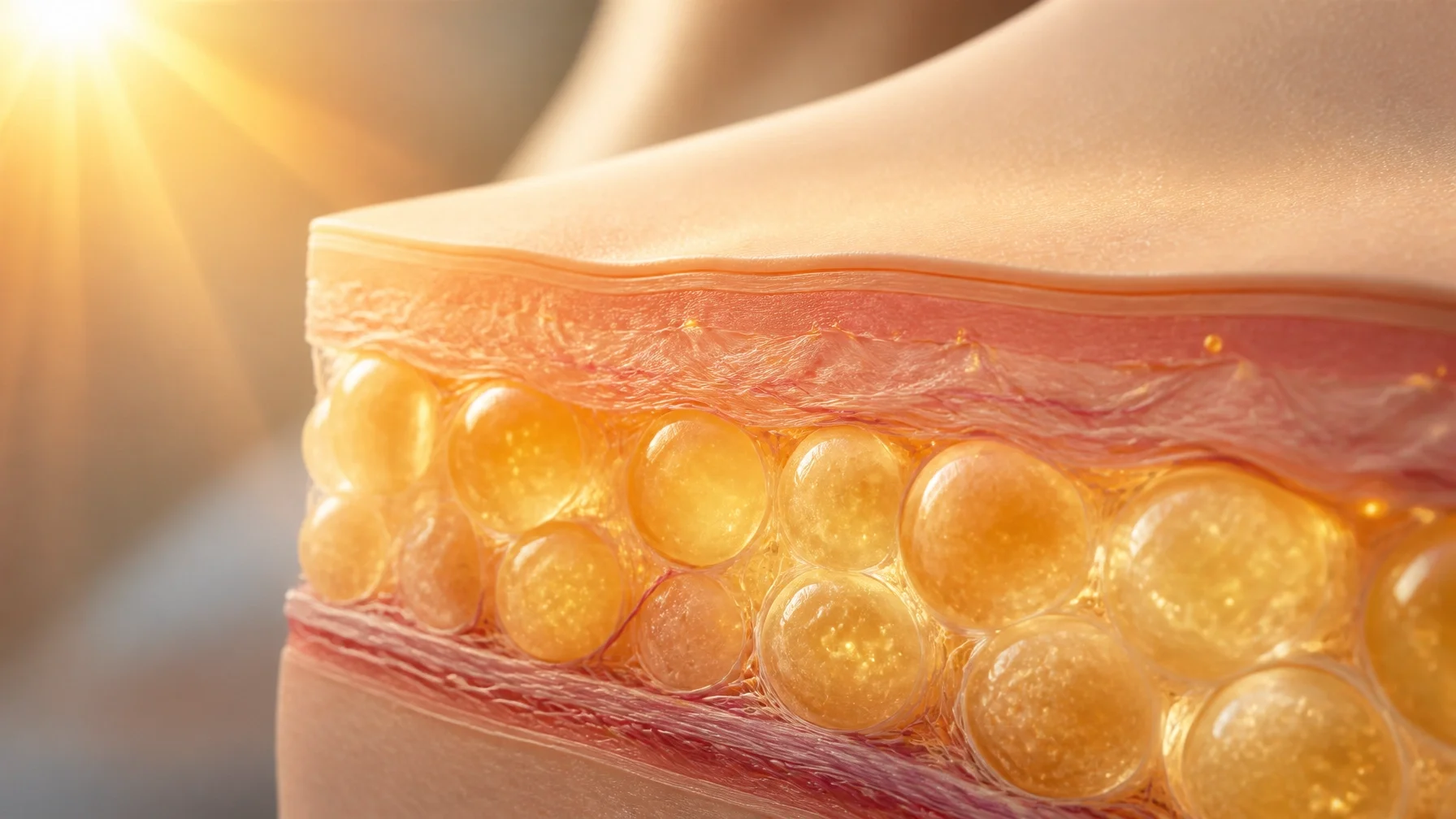
Skin and Fat Cells
One of the coolest things about Vitamin D is that your body can actually make it from sunlight.
Here’s the simplified version of the process:
In the skin, you have a compound called 7-dehydrocholesterol
When UVB light hits the skin, that compound is converted into a Vitamin D precursor
That precursor is then transformed into Vitamin D3 (cholecalciferol)
From there, it still has to go on a two-stop road trip before your body can really use it
Here’s the casual-but-important version of that activation process:
First, Vitamin D heads to the liver, where it is converted into 25-hydroxyvitamin D
Then it moves to the kidneys, where it becomes 1,25-dihydroxyvitamin D, the active form
In other words, Vitamin D doesn’t just clock in and start working. It needs clearance from the liver and kidneys first.
And yes—7-dehydrocholesterol is a cholesterol-related compound.
That little detail is a great reminder that cholesterol is not the villain it’s often made out to be. Your body uses cholesterol as raw material for some incredibly important jobs, and this is one of them.
Vitamin D isn’t just something you swallow in a capsule. It’s part of a beautifully designed internal chemistry set.
A quick sunscreen reality check
Here’s where things get a little awkward for the sun.
Because UVB rays are the trigger that help convert 7-dehydrocholesterol into the Vitamin D precursor, anything that heavily blocks UVB can also reduce your skin’s ability to make Vitamin D3.
That includes excessive sunscreen use, especially high-SPF products, which can act like a very polite bouncer at the door: “Sorry, UVB, your name’s not on the list.”
In other words, if UVB never gets the chance to hit the skin, your body’s natural D3 production can get ghosted before the process even starts.
That doesn’t mean sunscreen is “bad.” It just means there’s a real tradeoff to understand when talking about sunlight and Vitamin D production.
3. Your Fat-Cell Savings Account
Vitamin D is fat-soluble, and that changes the whole game.
Unlike water-soluble vitamins that move through the body more quickly, Vitamin D can be stored in adipose tissue—your body fat—especially in the tissue under the skin.
Think of it as your body’s Vitamin D savings account.
What that means:
Fat cells can store Vitamin D for later use
That stored supply can be released over time as the body needs it
This helps create a kind of internal reservoir or buffer system
It also helps explain why Vitamin D status can vary from person to person, even with similar intake
So when we talk about Vitamin D, we’re not just talking about what you took today. We’re also talking about what your body has been able to build, store, and access over time.
Pretty smart design, right?
What about testing?
This is where things get interesting.
A standard Vitamin D blood test usually measures what is circulating in the blood—basically your current checking account.
That’s useful, but it does not fully show the larger reserve of Vitamin D that may be stored in fat cells under the skin, which is more like your body’s savings account.
So if you only look at what’s floating around in the bloodstream, you’re not necessarily seeing the whole vault.
And this is where the Wisdom Within idea matters.
Your body’s Innate Intelligence knows how to manage resources better than we often give it credit for. It knows when to store, when to conserve, and when to unlock that Vitamin D vault and release what it needs, when it needs it most.
In other words, the lab slip can show part of the story—but the body is still running a much bigger operation behind the scenes.
4. The Master Regulator: 200 Genes and the Vagus Nerve
Vitamin D has earned a pretty impressive reputation in functional health circles, and for good reason.
It’s often described as a master regulator because it helps influence the activity of more than 200 genes related to cellular function, immune signaling, repair, and overall resilience.
That is not small stuff.
A few big reasons this matters:
It helps support healthy immune communication
It plays a role in Type I interferon signaling, which is part of the body’s first-line immune defense
It supports healthy neurological and inflammatory balance
It may help support parasympathetic tone, the “rest, regulate, and recover” side of the nervous system

And that brings us to the Vagus Nerve.
The Vagus Nerve is a major player in parasympathetic function. It helps the body shift out of stress mode and into a more restorative state. While Vitamin D is not a magic “vagus switch,” healthy Vitamin D status appears to support the broader environment in which balanced autonomic function can happen.
So if you like the idea of a gentle “Spring Reset”—more calm, more regulation, more resilience—Vitamin D belongs in that conversation.
5. Chiropractic Connection
Now let’s bring this back to what we do here.
Chiropractic care is about helping the body move better, adapt better, and function better. But structure matters. Tissue quality matters. Stability matters.
Vitamin D helps support:
Healthy bone density
Healthy calcium balance
Ligament and connective tissue integrity
Muscle and neuromuscular function
In practical terms, that means Vitamin D helps support the physical framework that your adjustments rely on.
No, Vitamin D does not “make an adjustment work” all by itself. But when your bones, ligaments, muscles, and nervous system are better supported, your body is often in a stronger position to maintain alignment, mobility, and functional stability.
That’s the bigger picture we care about at Carlucci Chiropractic & Wellness: not just temporary relief, but helping the body hold onto positive changes.
6. Functional Nutrition
If you want to support healthy Vitamin D status, food can absolutely be part of the strategy.
And as we always like to remind people: You are what you eat. Even more, As is your food, so is your mind. The quality of what you put into your body influences not only your physical health, but also your energy, focus, and resilience.
Vitamin D-rich foods to include:
Fatty fish like salmon, sardines, and mackerel for naturally occurring Vitamin D3
Egg yolks for naturally occurring Vitamin D3
Cod liver oil
Beef liver
Fortified dairy products
Fortified plant milks
Fortified cereals
Mushrooms exposed to UV light, which provide Vitamin D2
A few quick notes:
Food alone may not always be enough for everyone
Sun exposure, skin tone, season, age, and body composition can all affect Vitamin D status
Some people may benefit from personalized testing and guidance rather than guessing
That’s where a more functional, individualized approach can make a big difference.
Grocery Store Pro-Tip
Next time you’re scanning labels on plant milks and cereals, take a peek at the Vitamin D source.
A lot of the time, you’ll see Vitamin D2 or a synthetic fortified addition showing up on the ingredient list.
Is that better than nothing? Sure—think of it as a backup singer.
But let’s be clear: “fortified” does not automatically mean “superior.”
Your body tends to do best with the real-deal D3 from whole foods like fatty fish and egg yolks, or the D3 your skin naturally makes from sunlight when UVB gets the green light.
So yes, fortification can help fill a gap. But from a Wisdom Within perspective, your body’s Innate Intelligence generally prefers the higher-quality, more natural inputs over the nutritional equivalent of a patch job.
In short: fortified can be helpful, but it’s still the backup plan—not the headliner.
Closing Thoughts
Vitamin D is a lot more than a seasonal wellness buzzword.
It’s a hormone-like nutrient, a master regulator, a supporter of bone and ligament health, a partner in immune readiness, and yes—a surprisingly clever substance your body can store in its own internal reservoir.
When we look at health through the Wisdom Within lens, Vitamin D is a perfect example of how the body is designed to work with light, structure, chemistry, and adaptation all at once.
If you’re looking for a more personalized path to better mobility, nervous system balance, and whole-body wellness, we’d love to help.
Ready to support your foundation from the inside out?
Explore our care and wellness approach: https://www.carluccichiropractic.com/
Connect with Dr. K here: https://linktr.ee/DrKCarlucci
These statements have not been evaluated by the FDA. This content is for educational purposes only and not intended as medical advice.
